The Meaning Behind Traditional Samurai Armor: Symbolism, Status, and Spirit

A samurai's armor wasn't just protection—it was a walking poem.
Every cord, plate, and ornament carried intention. The yoroi (armor) didn't simply shield the body; it broadcast lineage, announced rank, and embodied the warrior's relationship with death itself. To understand samurai armor is to read a language written in iron, silk, and lacquer.
The Face That Stared Back at Death
The menpō (face mask) did more than deflect arrows. Its fierce grimace—complete with mustache, fangs, sometimes even a demonic snarl—served a dual purpose. It terrified enemies, yes. But it also transformed the wearer.
Slipping on that mask meant leaving the everyday self behind. You became the role. The scowl wasn't vanity; it was ritual, a psychological threshold between the mundane and the battlefield. Some masks even included detachable nosepieces, allowing the warrior to drink or eat without fully removing their second face.
Color as Declaration
Samurai didn't dress for camouflage. They dressed to be seen.
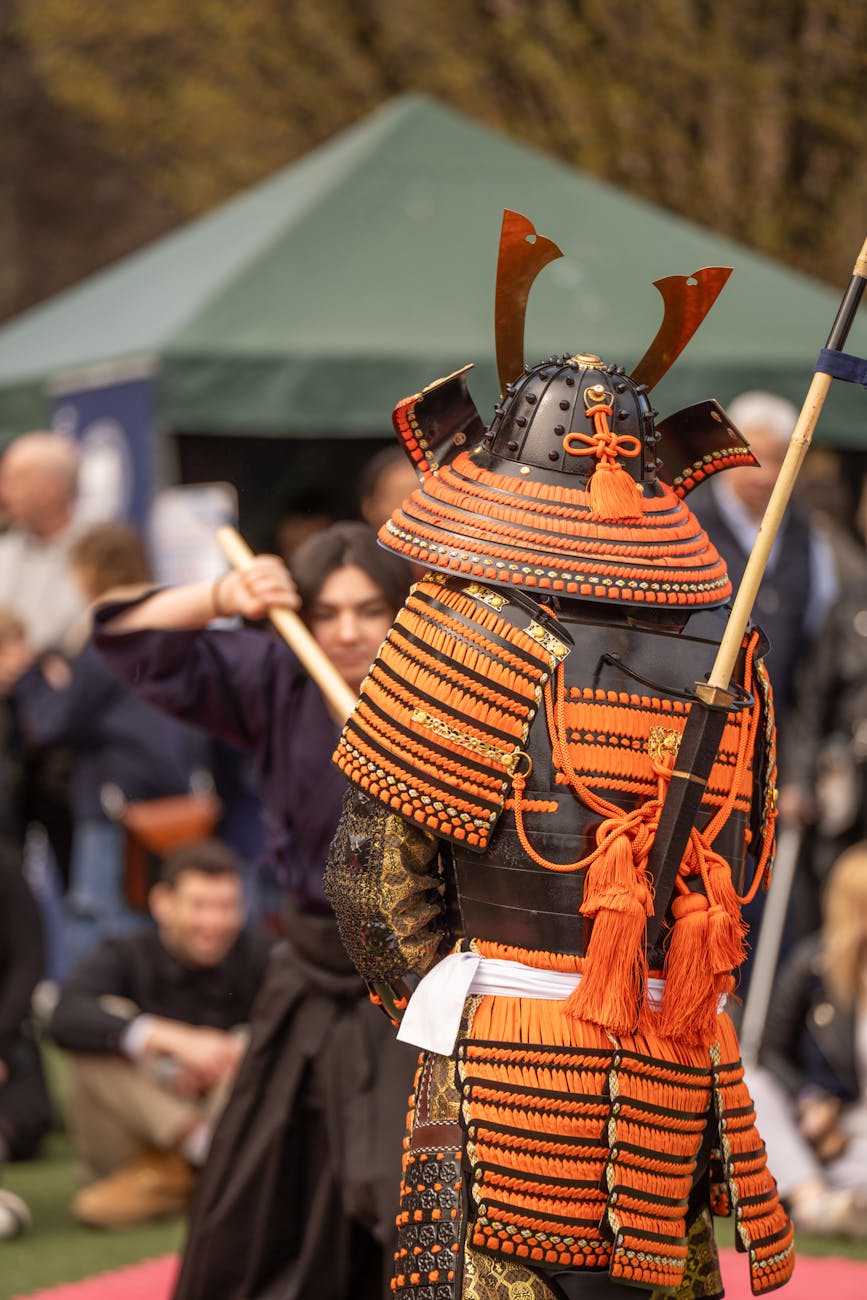
The odoshi (lacing) that bound hundreds of small plates together came in deep crimsons, indigos, whites, and golds. A general might wear purple—reserved for high rank. A young warrior from a proud clan might choose red, the color of vigor and blood lineage. These weren't arbitrary choices. They were heraldic statements, readable across a battlefield thick with dust and confusion.
The armor announced who you were before you ever drew your sword.
Even the sode (shoulder guards) flared outward like wings, enlarging the silhouette, making the samurai appear larger than life. Presence mattered as much as protection.
The Knot That Couldn't Be Untied
At the center of the chest plate sat the agemaki—a large, decorative knot of silk cord. Ornamental, certainly. But also symbolic.
The knot represented the warrior's resolve, tied so tightly it could never come undone in battle. Some historians suggest it also symbolized the bond between lord and retainer, a relationship considered more sacred than family. The agemaki wasn't functional in the mechanical sense. It was functional in the spiritual sense—a constant reminder of duty worn directly over the heart.
Horns, Crests, and Cosmology
The kabuto (helmet) often sprouted elaborate crests—maedate—shaped like crescent moons, antlers, or even stylized flames. These weren't mere decoration.
The crescent moon invoked Buddhist imagery of enlightenment emerging from darkness. Antlers referenced deer, creatures of the sacred mountain forests. Some warriors wore family crests; others chose symbols tied to their personal philosophy or patron deity. The helmet transformed the head into an altar, a moving shrine to whatever forces the samurai believed governed fate.
Before battle, many warriors would burn incense inside their helmets. The scent would linger as they fought—a reminder of ritual, of the world beyond steel and mud.
What the Armor Knew
Samurai armor was designed to be donned with help. You couldn't wear it alone.
This wasn't a flaw—it was a feature. The process required attendants, reinforcing the samurai's place within a web of loyalty and service. Even in the intimate act of preparing for death, you were never solitary. The armor insisted on it.
When you see a suit of yoroi in a museum, you're looking at a philosophical system made tangible. Every element—from the throat guard to the shin plates—carried meaning layered upon meaning. Protection, yes. But also identity, cosmology, theater, and prayer.
The warrior wore his entire world on his back.
FAQ
Chaware curates authentic Japanese crafts — straight from the makers in Japan to your table.
Explore the Chaware collection →