How Japanese Tea Is Grown: From Terraced Fields to Your Cup
The tea plant doesn't just grow in Japan—it's cultivated with an intensity that borders on obsession. Every leaf that becomes your cup of sencha or gyokuro has been shaded, pruned, and harvested according to rhythms perfected over centuries.
The mountain decides the flavor
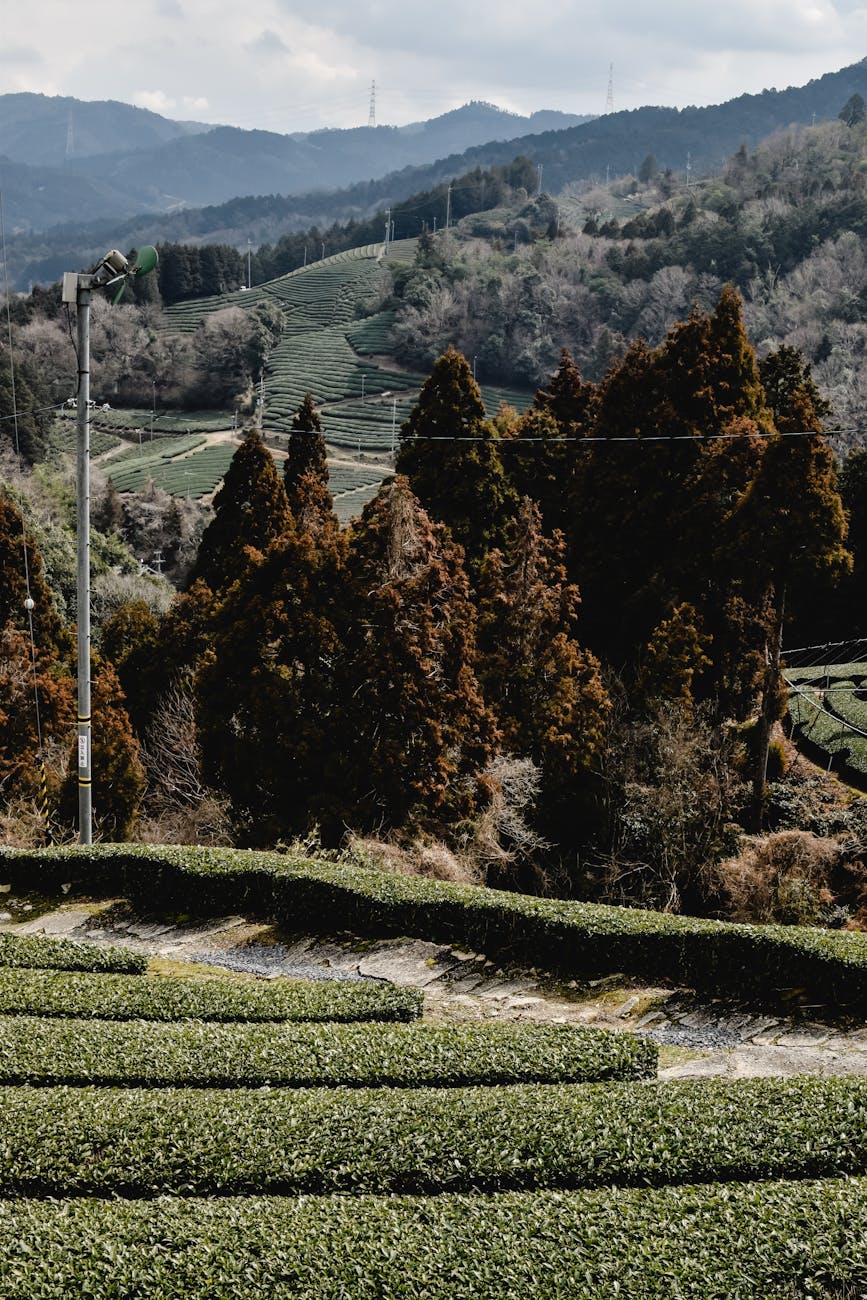
Japanese tea farmers will tell you that great tea begins with terroir—the particular marriage of soil, altitude, and mist that gives each growing region its signature. The hills of Uji, Shizuoka, and Kagoshima don't just produce tea; they produce place in liquid form.
Tea plants (Camellia sinensis) thrive in well-drained, slightly acidic soil, typically on slopes where morning fog lingers and afternoon sun warms the leaves. The elevation matters. Higher altitudes slow growth, concentrating flavor compounds in the leaves. Lower temperatures mean smaller, more tender buds—the ones that yield the most prized harvests.
Most Japanese tea comes from cultivars bred specifically for the archipelago's climate. Varietals like Yabukita dominate commercial production, chosen for their balance of umami and resilience.
Darkness creates sweetness
Here's where Japanese tea cultivation diverges dramatically from the rest of the world: intentional shading.
For premium teas like gyokuro and matcha, farmers cover the tea plants with black fabric or bamboo screens weeks before harvest. This ooishita saibai (shade-growing) technique blocks up to 90% of sunlight, forcing the plant into a kind of photosynthetic panic. It responds by flooding its leaves with chlorophyll and L-theanine—the amino acid responsible for tea's savory umami depth and that distinctive sweet-grassy flavor.
Shade doesn't just change the taste; it transforms the entire chemical architecture of the leaf.
The practice requires precision. Shade too early, and you lose yield. Too late, and the flavor shift never happens. Farmers adjust the coverage daily, reading the plants like a language only they speak.
The first flush is everything
Japanese tea operates on a strict seasonal calendar. The first harvest—shincha or ichibancha—happens in late April or early May, when tender new shoots emerge after winter dormancy. These young leaves contain the highest concentration of nutrients and flavor. They're plucked by hand or machine, depending on the grade, often in the early morning when dew still clings to the stems.
Second and third flushes follow through summer, but they never match the complexity of that first spring picking. By autumn, some fields are pruned severely, cut back to stumps that look almost brutal. But this aggressive trimming ensures vigorous growth the following spring.
Between harvests, tea fields are landscapes of careful intervention—fertilizing with organic matter, managing pests without heavy chemicals, aerating soil, controlling weeds. It's agriculture as choreography.
Hands or machines, both require devotion
Walk through a tea field during harvest and you might see both: elderly farmers plucking leaves by hand with practiced speed, and mechanical harvesters straddling rows like industrial insects. Hand-picking allows selection of only the finest leaves—one bud and two leaves, the classic standard. Machines are faster, more economical, and increasingly sophisticated.
Neither method is inherently superior. What matters is the farmer's knowledge of when to harvest, which leaves to take, and how to handle them in the crucial hours after picking. Once cut, tea leaves begin to oxidize. Japanese tea processing halts this immediately through steaming—but that's another story.
The tea plant itself is remarkably hardy, living for decades if tended properly. Some production fields in Shizuoka are over fifty years old, their gnarled branches still producing leaves that become someone's morning ritual halfway across the world.
The best tea tastes like the mountain it came from—and the hands that knew exactly when to cut.
FAQ
Chaware curates authentic Japanese crafts — straight from the makers in Japan to your table.
Explore the Chaware collection →