The Quiet Genius of Miso Paste: Japan's Ancient Kitchen Essential
On this page
There's a jar in almost every Japanese kitchen that holds more than seasoning. It holds time itself.
Miso paste—the thick, earthy, deeply savory paste made from fermented soybean—sits quietly in the corner of refrigerators, unassuming and essential. It doesn't announce itself the way soy sauce does. It doesn't have the visual drama of fresh wasabi or the mystique of matcha. Yet without it, the entire architecture of Japanese home cooking would collapse.
The taste that wakes up the kitchen
Miso doesn't just flavor food. It anchors it.
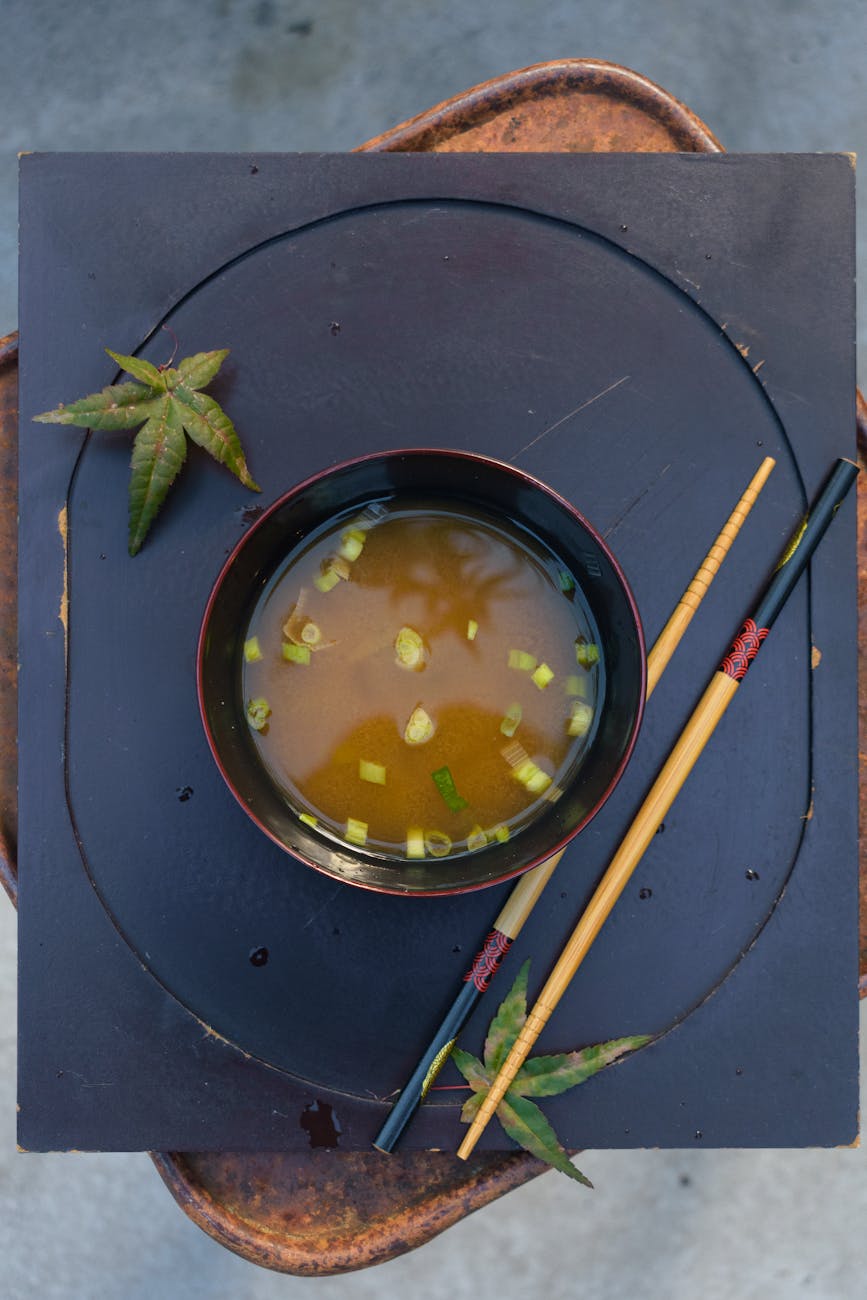
That first sip of miso shiru (miso soup) in the morning—warm, cloudy, faintly sweet, deeply umami—is how millions of Japanese people begin their day. Not with coffee. Not with toast. With fermentation. The broth carries dissolved miso, tender cubes of tofu, slippery wakame seaweed, perhaps a few threads of green onion. It's simple to the point of invisibility, yet it centers the meal, the morning, the body.
The magic is in what miso does to other ingredients. It doesn't mask them. It deepens them. A glaze of miso on grilled eggplant transforms the vegetable into something almost meaty. A spoonful stirred into a simmering pot coaxes out flavors you didn't know were there.
Fermentation as patience
Miso is what happens when you trust microbes with your food—and wait.
The base is deceptively modest: soybeans, salt, and koji (a mold culture grown on rice or barley that breaks down starches into sugars). These three elements are mixed, packed into wooden barrels or ceramic crocks, and left alone. For months. Sometimes years. The koji enzymes work slowly, transforming firm beans into a paste that tastes of earth, caramel, nuts, and something harder to name—a kind of rounded, mellow complexity the Japanese call kokumi, the "mouthfulness" beyond the five basic tastes.
Miso doesn't announce itself the way other seasonings do—it simply makes everything else taste more like itself.
Different regions produce different styles. Shiro miso from Kyoto is pale, sweet, aged only briefly. Aka miso from central Japan is rust-red, saltier, fermented longer. Hatcho miso from Aichi uses only soybeans and takes up to three years to mature, emerging dark as chocolate and intensely savory. Each carries the fingerprint of its place: the water, the climate, the particular strain of koji passed down through generations of makers.
The invisible backbone
Walk into a Japanese home kitchen and miso is everywhere, even when you can't see it.
It's whisked into dressings for blanched greens. It's spread on rice balls and grilled until blistered. It's the secret depth in a pot of simmered vegetables, the glaze on dengaku tofu skewers sold at festivals, the marinade that tenderizes fish overnight. Grandmothers keep small containers of homemade miso in the back of the fridge, each batch slightly different, each one irreplaceable.
This isn't chef wizardry. It's everyday alchemy. Miso belongs to the home, to the hands that stir it into hot water without measuring, to the intuition that knows when a dish needs just a little more roundness, a little more soul.
What time tastes like
There's something fundamentally Japanese about miso: the willingness to wait, to let transformation happen in the dark, to trust that time will make something better than speed ever could.
It's fermentation as philosophy. And it's sitting in a jar, right now, in a kitchen somewhere, ready to turn water into comfort.
FAQ
Chaware curates authentic Japanese crafts — straight from the makers in Japan to your table.
Explore the Chaware collection →