Why Japanese Tie Omikuji Paper Fortunes at Shrines: Meaning and Tradition
On this page
You pull a thin paper slip from a wooden box, unfold it, and find your fortune isn't quite what you hoped. So you do what thousands before you have done: you tie it to a pine branch and walk away lighter.
The weight of words on paper
Omikuji — those folded paper fortunes sold at Shinto shrines and Buddhist temples across Japan — aren't souvenirs. They're messages believed to carry the will of the kami or Buddha, revealed through a ritualized form of chance. You shake a hexagonal box until a numbered stick falls out, then exchange it for the corresponding paper fortune. What's written inside might be daikichi (great blessing) or kyo (curse), with gradations of luck in between.
The paper itself feels deliberate. Thin but sturdy, often with a slight texture. The ink is black, the characters precise. Reading it feels like opening a letter from someone who knows something you don't.
When bad luck needs somewhere to go
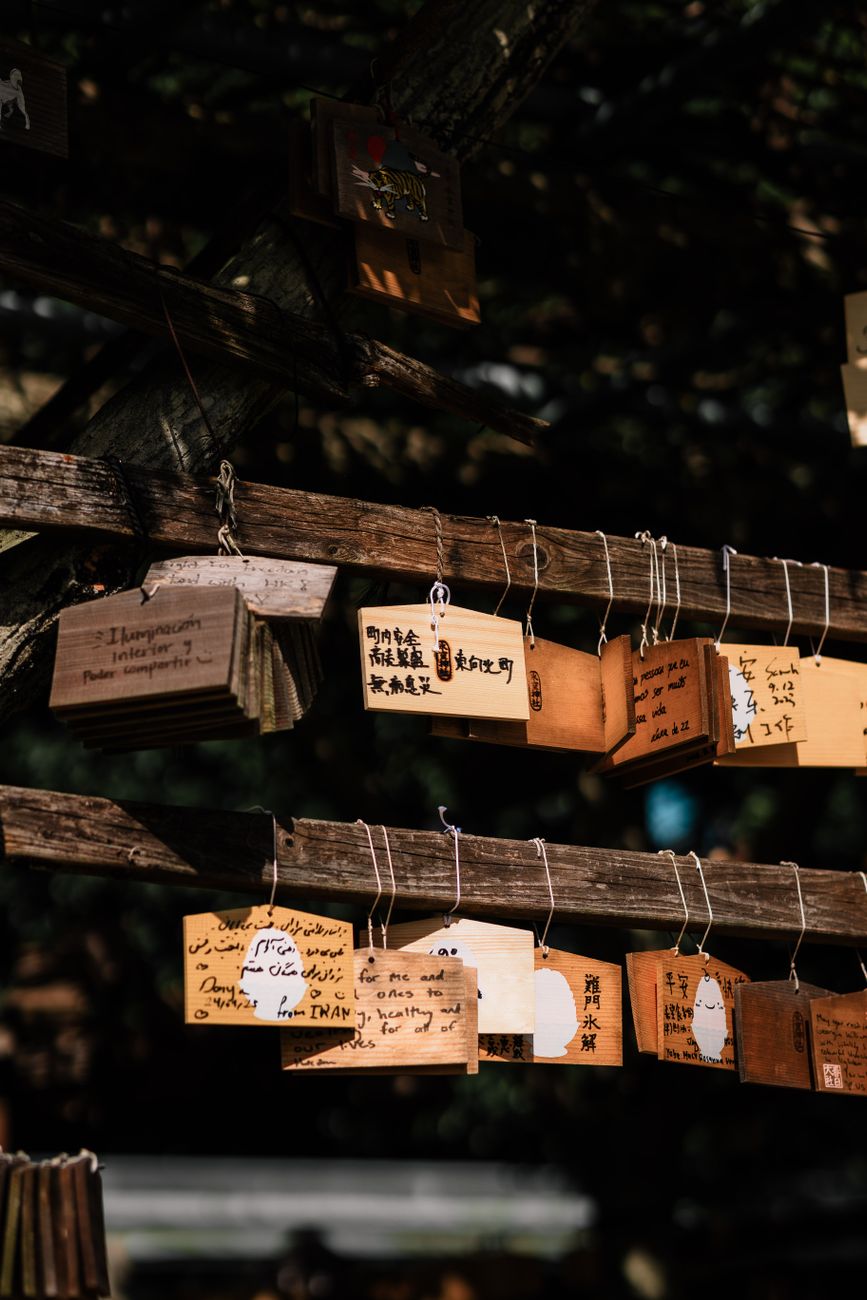
Here's the thing: if your fortune is unfavorable, you're supposed to tie it at the shrine and leave it behind. The act isn't superstition dressed up as tradition — it's a form of symbolic transfer. By binding the paper to a tree, fence, or designated wire rack, you're asking the divine presence of that place to hold onto the misfortune so you don't have to carry it home.
Tying the paper isn't about escaping fate, but about asking for help shouldering it.
The knot matters. You fold and tie carefully, often using only one hand as an added challenge — a small act of focus and intention. Some say this difficulty itself is a prayer.
What happens to good fortunes
If you draw daikichi or another favorable fortune, you face a choice. Many people keep it, tucking it into a wallet or journal as a reminder. Others still tie it at the shrine, viewing it as an offering of gratitude or a way to deepen the blessing's roots in sacred ground.
There's no single correct practice. What's consistent is the seriousness with which people approach the moment — the pause before deciding, the care in folding. Even in a crowd of tourists and school groups, you'll see individuals go quiet when they read their fortune, as if the noise has briefly fallen away.
The trees that hold ten thousand hopes
Walk through the grounds of popular shrines like Fushimi Inari or Sensoji, and you'll see entire sections transformed into paper forests. Hundreds of omikuji flutter from pine branches, their white and pale colors catching the light like blossoms. Shrine staff collect and ritually burn them periodically, releasing the prayers and misfortunes skyward.
The practice ties back to Shinto concepts of musubi — binding, connection, the act of bringing things together. A knot is never just a knot. It's a physical manifestation of relationship: between you and the kami, between your present self and your hoped-for future, between the weight you carried in and the possibility of leaving lighter.
The wind moves through the branches. The papers whisper and turn. And somewhere in that rustling is the quiet belief that words, once written and tied, can be transformed into something else entirely.
FAQ
Chaware curates authentic Japanese crafts — straight from the makers in Japan to your table.
Explore the Chaware collection →