Kaga Yuzen: The Art of Hand-Painting Kimono in Kanazawa
On this page
The silk whispers of seasons past—a peony petal curling at its edge, a leaf traced with the delicate scars of an insect's hunger. In Kanazawa's quiet workshops, brushes loaded with crimson and indigo bring gardens to life on fabric, one careful stroke at a time.
The Painter Who Changed a City
In 1712, a Kyoto fan-painter named Miyazaki Yuzensai (宮崎友禅斎) arrived at the Taroudaya dyehouse in Kanazawa and set in motion a transformation. His techniques, applied to the existing dyeing traditions of the castle town, elevated Kaga yuzen (加賀友禅) into one of Japan's three great yuzen dyeing traditions. Where Kyoto's yuzen would grow ornate with embroidery and gold leaf, Kanazawa's path diverged toward something quieter—a painterly realism that let nature speak without embellishment.
Five Colours, Infinite Gardens
At the heart of Kaga yuzen lies the Kaga gosai (加賀五彩), the five foundational colours that define its palette: enji (crimson), ai (indigo), oudo (ochre), kusairo (grass green), and komurasaki (ancient purple). These are not arbitrary choices but a distillation of the natural world as seen through Kanazawa's seasons—the deep crimson of camellia, the faded purple of wisteria past its prime, the particular green of new leaves in spring rain. From these five, dyers blend countless gradations, building depth through layering rather than brightness.
The Beauty of Imperfection
Look closely at a Kaga yuzen kimono and you may notice something unexpected: leaves with ragged edges, petals with holes, stems showing signs of decay. This is mushikui (虫喰い), literally 'insect-eaten,' a motif that sets Kaga yuzen apart from other dyeing traditions. Where perfection might seem the obvious goal, Kaga artisans instead celebrate the marks of time and nature's appetite. A leaf nibbled by insects becomes more real, more alive—a reminder that true beauty includes the passage of seasons and the small violences of the natural world.

Brushwork Without Shortcuts
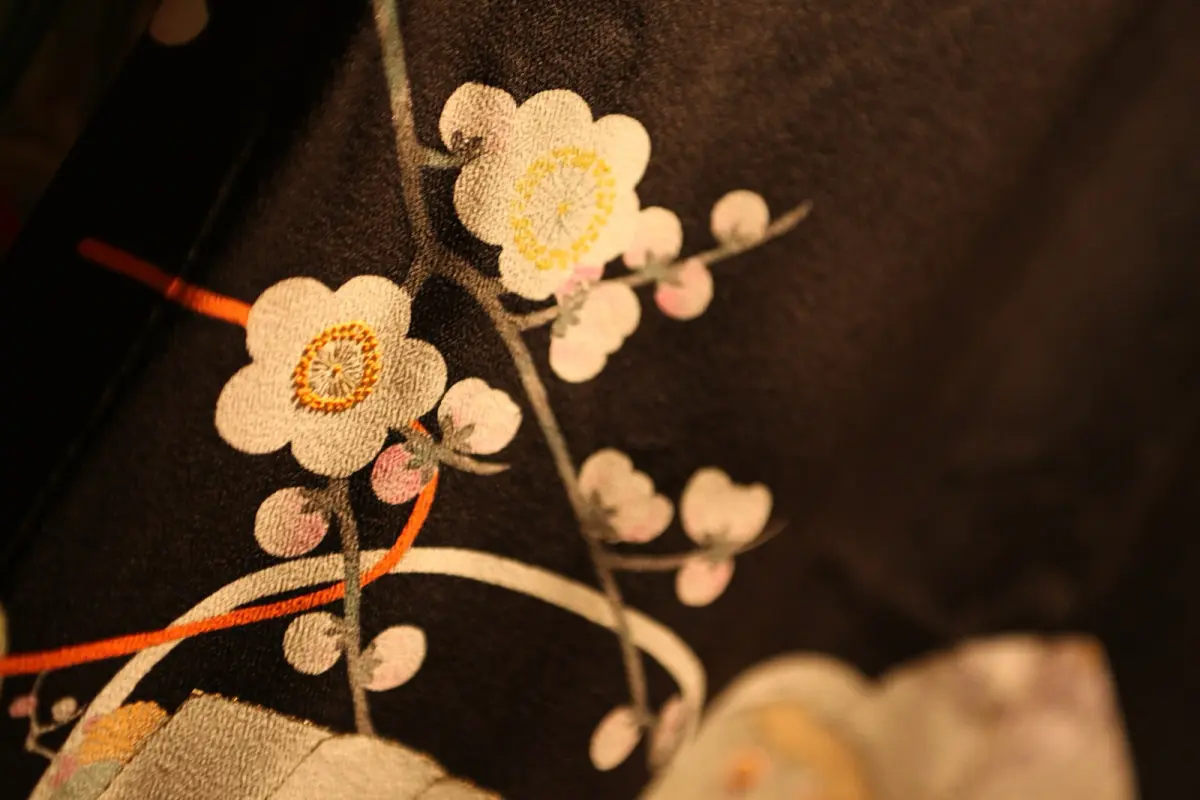
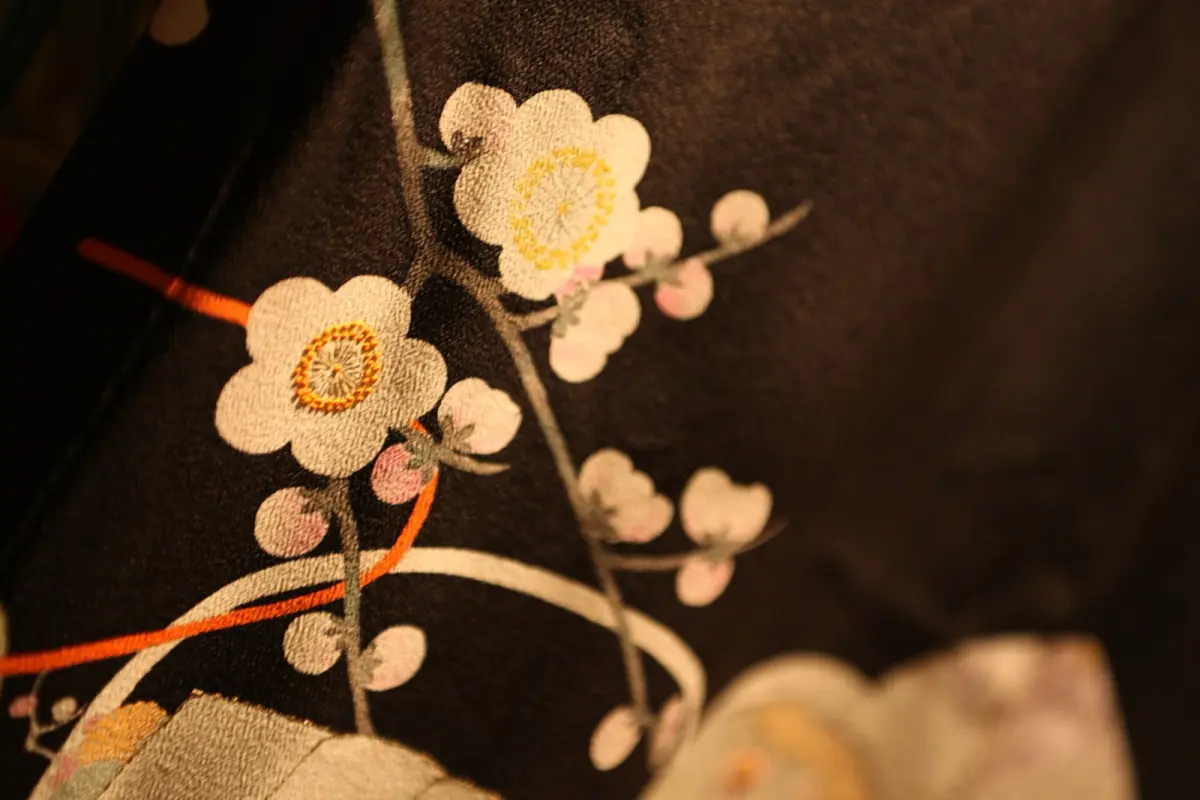
Kaga yuzen is entirely hand-painted, each design built up through patient brushwork on silk. The technique of bokashi (暈し)—gradual shading that moves from deep colour to pale or from one hue to another—requires both technical control and an artist's eye. Unlike Kyoto yuzen, which often incorporates embroidery or gold leaf to add dimension and luxury, Kaga yuzen relies almost exclusively on the brush and dye. The result is softer, more painterly, with a naturalism that can make flowers seem to tremble on the fabric:
Petals fade from crimson heart to pale edge, leaves shift from spring green to autumn ochre, all without a single stitch of thread or flake of gold to distract from the dyer's hand.
A Living Tradition in Kanazawa
Today, Kaga yuzen remains rooted in Kanazawa, Ishikawa Prefecture, where workshops continue the methods refined over three centuries. The city's position as a prosperous castle town under the Maeda clan provided both patronage and a culture of refined taste that nurtured the craft. Modern artisans still begin with the same five colours, still paint insects' traces onto leaves, still build their gradations stroke by patient stroke. The tradition has adapted—new designs emerge, contemporary sensibilities find expression—but the fundamental approach remains unchanged: nature observed closely, rendered faithfully, celebrated in all its transient, imperfect beauty.
When you hold Kaga yuzen silk to the light, you're seeing not decoration but devotion—to seasons, to the hand's honest work, to beauty that includes the bite marks.
FAQ
Chaware curates authentic Japanese crafts — straight from the makers in Japan to your table.
Explore the Chaware collection →
Keep exploring


