Hakone Yosegi: The Art of Japanese Mosaic Woodwork From Mountain Forests
On this page
Article Body
Along the old Tōkaidō road, where travellers once paused before crossing the mountain pass, a woodworker named Ishikawa Nihei began fitting together pieces of contrasting timber into patterns so precise they seemed woven rather than carved. What he started in Hakone around the early 1800s became a tradition that still catches the eye of anyone who opens a geometric puzzle box or runs their fingers across a patterned wooden surface.
Patterns Born from Mountain Forests
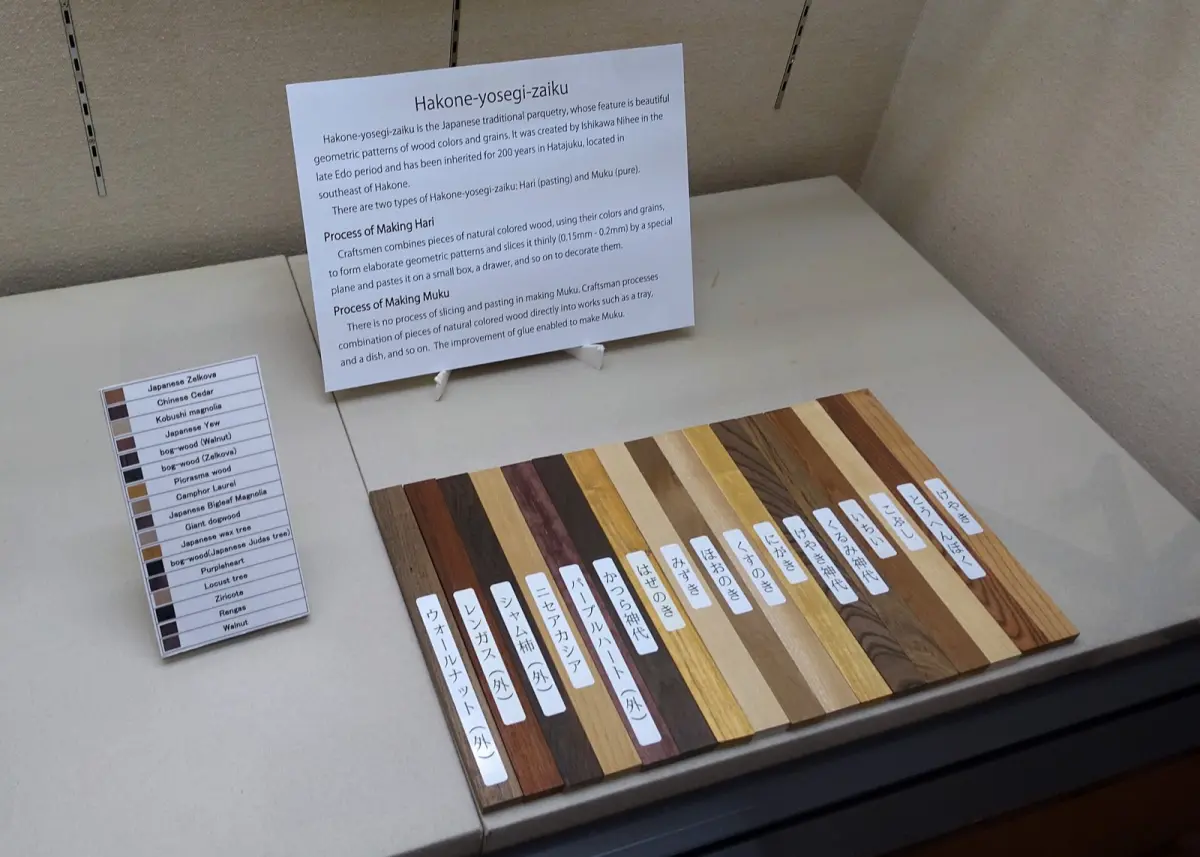
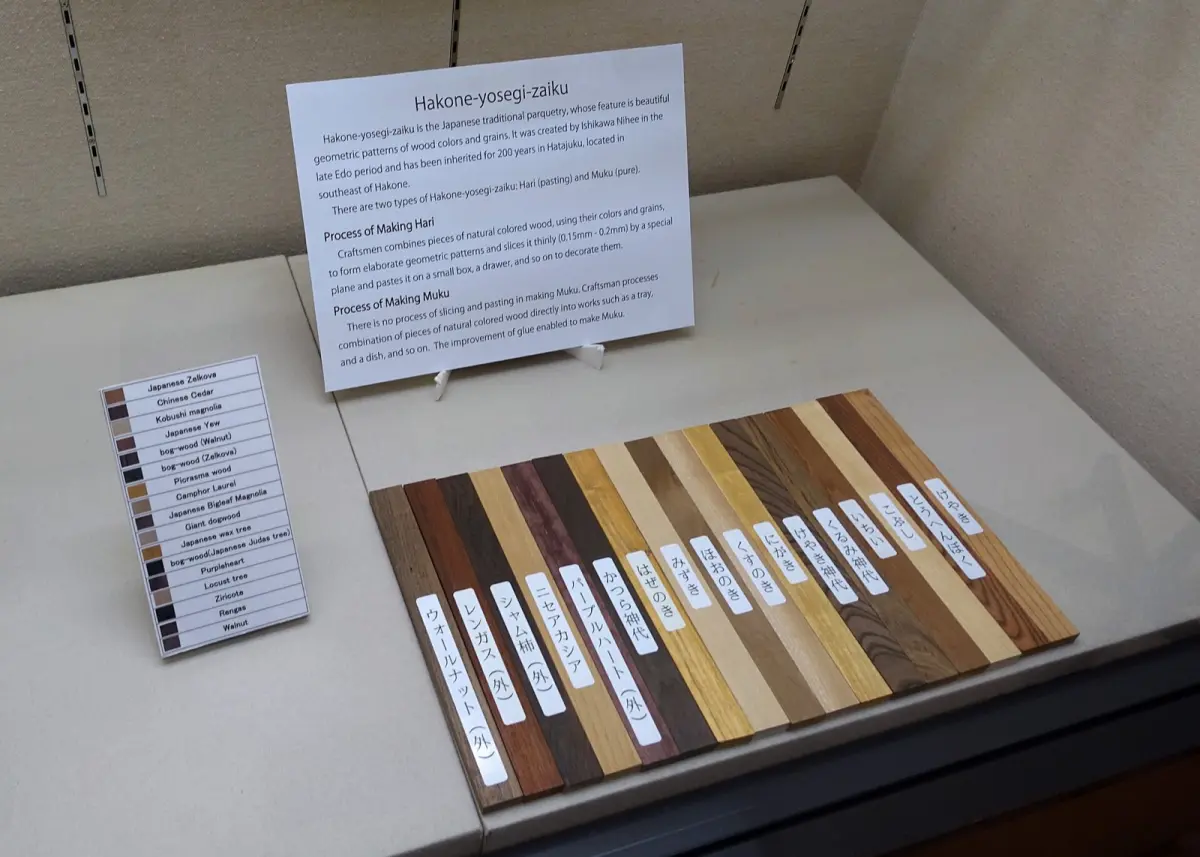
Hakone's steep slopes harbour an unusual variety of tree species, each with its own natural colour and grain. This abundance gave local craftspeople a palette to work with: the pale cream of katsura (桂), the warm brown of keyaki (欅), the grey-green of mizuki (水木), and dozens more. Hakone yosegi marquetry (箱根寄木細工) takes these woods and assembles them—without stain or dye—into geometric patterns that range from simple stripes to intricate star-bursts and interlocking diamonds. The technique relies entirely on the natural contrast between timbers, a constraint that has shaped its aesthetic for two centuries.
The Founder's Journey
The craft's origin traces to Ishikawa Nihei (1790–1850), a resident of Hatajuku, one of the post towns serving travellers on the Tōkaidō route. Ishikawa brought marquetry techniques from Shizuoka and adapted them to Hakone's particular woods and market. The timing mattered: Hakone was already known for woodworking, and the steady flow of travellers crossing the Hakone pass created demand for distinctive souvenirs. What began as one craftsman's innovation grew into a regional specialty, passed through generations of makers who refined the patterns and techniques.
Three Distinct Methods
Hakone marquetry encompasses three main approaches, each suited to different objects:
Zuku-bari (ヅク張り) involves planing patterned wood blocks into paper-thin sheets, then adhering them to the surface of boxes, trays, or other items—a technique that allows complex patterns to wrap around curved forms.
Muku-zukuri (ムク作り) works the patterned blocks themselves into solid objects, carving and shaping them so the design runs through the entire piece. A coaster made this way shows the same pattern whether you look at the top, bottom, or edge.
Kizougan (木象嵌) takes a different path entirely, inlaying shaped pieces of wood into a base surface to create pictorial scenes rather than geometric repeats—think landscapes or flowers rather than tessellations.

The Secret Box Tradition
Among Hakone's marquetry products, the himitsu-bako (秘密箱)—secret boxes—became particularly famous. These puzzle boxes require a specific sequence of sliding panels to open, sometimes involving four moves, sometimes forty. The exterior displays the characteristic geometric patterns, but the real appeal lies in the mechanical ingenuity hidden within. They became emblematic Hakone souvenirs, small enough to carry home but intricate enough to puzzle friends for hours. The tradition continues, with contemporary makers still crafting these boxes alongside more conventional items like trays, coasters, and decorative panels.
Recognition and Continuity
In 1984, Hakone yosegi marquetry received designation as a Traditional Craft, formal recognition of its historical significance and continued practice. The designation acknowledges not just the aesthetic achievement but the technical knowledge required: understanding how different woods behave, how to cut and assemble them so patterns align perfectly, how to finish surfaces so the natural colours remain vivid. Workshops in Hakone still teach these methods, and visitors to the region can watch craftspeople plane those impossibly thin sheets or assemble the tiny wooden rods that will become tomorrow's patterns.
The craft endures because it solved a particular problem elegantly—how to make wood itself into decoration—and because each piece still carries the mark of the forests that surround the workshops where it was made.
FAQ
Chaware curates authentic Japanese crafts — straight from the makers in Japan to your table.
Explore the Chaware collection →
Keep exploring


