Kihachijo: The Yellow Silk of Hachijojima
On this page
Article Body
On a speck of volcanic land sixty kilometres south of Tokyo, weavers still coax three colours from island plants, just as their ancestors did when silk bolts travelled north as tribute to distant lords. Honba Kihachijo (本場黄八丈) — literally 'authentic yellow hachijō' — is the silk that grew from isolation, where every hue tells the story of Hachijojima's earth and flora.
An Island Tribute Woven Into History
Hachijojima sits alone in the Pacific, a small island in the Izu chain that belongs, improbably, to Tokyo. Records from the Muromachi period (1336–1573) show that silk from this remote outpost was already valuable enough to be sent as tribute in place of tax. For centuries, the island's weavers worked in relative obscurity, their cloth known mainly to officials and the wealthy. It was only in the late Edo period (early 19th century) that kihachijo spread beyond the elite, becoming a treasured textile among townspeople who prized its subtle beauty and exceptional durability.
Three Colours, Three Island Gifts
The palette of honba kihachijo is entirely botanical, drawn from plants that thrive in Hachijojima's volcanic soil and maritime climate. The signature yellow comes from kariyasu (刈安), a grass known botanically as kobunagusa, which yields a clear, luminous gold when its fibres are steeped and simmered. The warm reddish-brown called kaba (樺) is extracted from the bark of the tabu tree, a broadleaf evergreen native to these southern islands.
The black is perhaps the most remarkable: chinquapin bark provides the tannins, but the true depth comes from dorozome (泥染め), a fixing process using the island's iron-rich mud that transforms brown into a lustrous near-black.
Each colour requires patience — yellow threads may be dyed and dried dozens of times to achieve the proper intensity, a rhythm dictated by sun and season rather than schedule.
Stripes and Checks on the Handloom
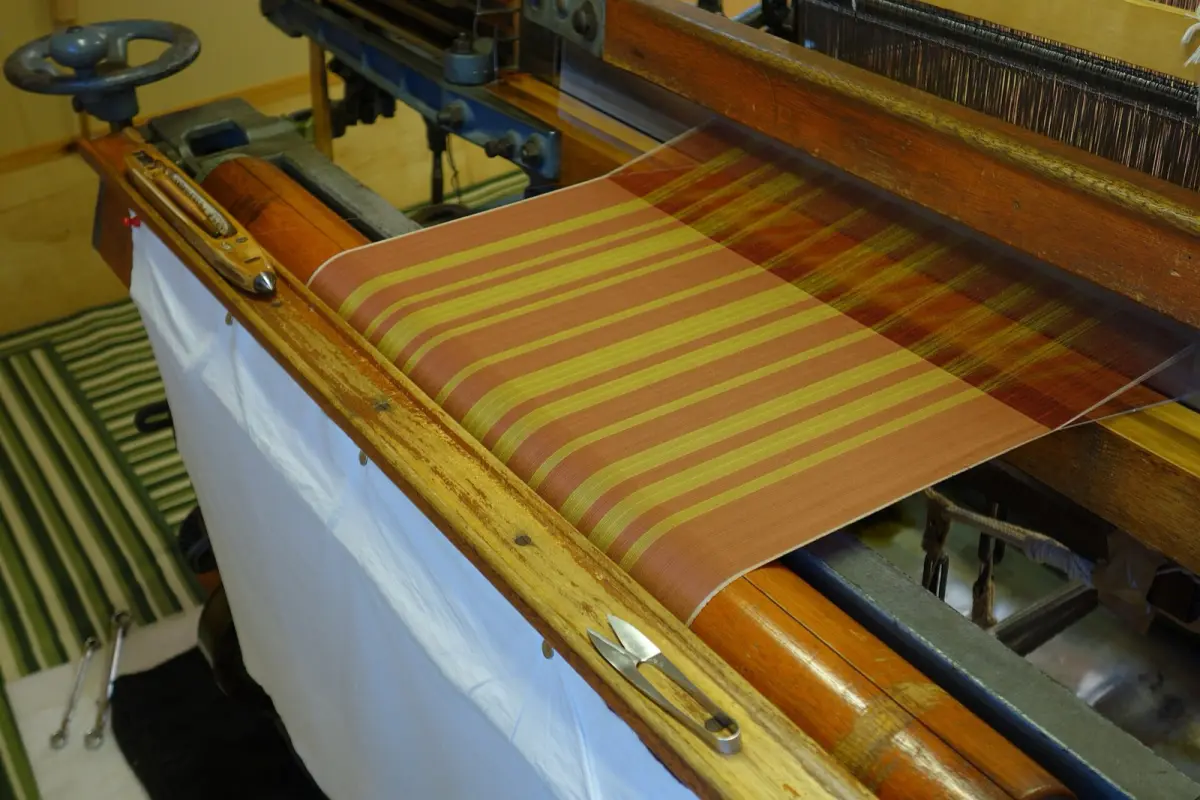
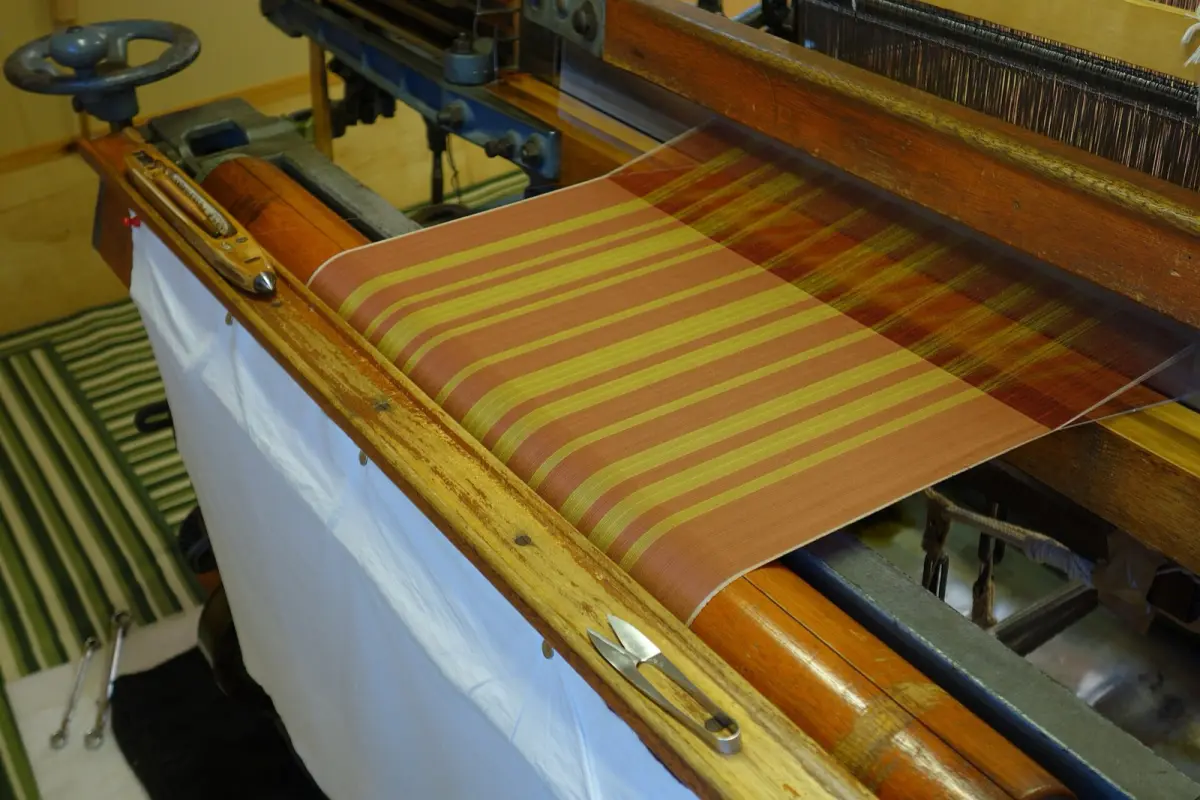
Once dyed, the silk threads are arranged on traditional handlooms into the patterns that define kihachijo: vertical stripes of varying widths and precise checks formed by the interplay of warp and weft. These geometric designs are deceptively simple, their elegance lying in proportion and the subtle gradations where one colour meets another. The weaving itself is slow, meditative work. Each bolt emerges with a crisp hand and a slight stiffness that softens with wear, the silk growing more supple against the body while retaining its structure. The cloth resists creasing and, weavers say, seems to improve with age — a quality that made it practical for island life and desirable far beyond.

Recognition and Continuity
In 1977, honba kihachijo received designation as a national Traditional Craft, formal recognition of techniques preserved across generations on this small island. The designation came with specific criteria: the silk must be dyed using only the three traditional plant sources, the mud-fixing for black must use Hachijojima's own iron-rich earth, and the weaving must be done entirely by hand. Today, only a handful of artisans maintain the full cycle of production, from cultivating dye plants to the final pass of the shuttle. The knowledge is exacting — when to harvest kariyasu, how long to steep tabu bark, the precise chemistry of mud and tannin that yields true black.
Wearing the Island
To wear honba kihachijo is to carry a piece of Hachijojima's landscape: the gold of windswept grasses, the russet of forest bark, the black earth shot through with volcanic iron. The silk moves between restraint and richness, its stripes and checks equally at home in a formal setting or a quiet afternoon. In an age of synthetic dyes and power looms, these textiles remain stubbornly, beautifully slow — each bolt a testament to what an island and patient hands can make.
The colours hold, season after season, as steadfast as the island itself.
Chaware curates authentic Japanese crafts — straight from the makers in Japan to your table.
Explore the Chaware collection →
Keep exploring


